


How many leads does your B2B SaaS team need to hit its revenue target? Start with your goal for new annual recurring revenue (ARR), then work backwards through closed deals, opportunities, sales-qualified leads (SQLs), marketing-qualified leads (MQLs) and total leads.
1. Translate the revenue target into closed deals
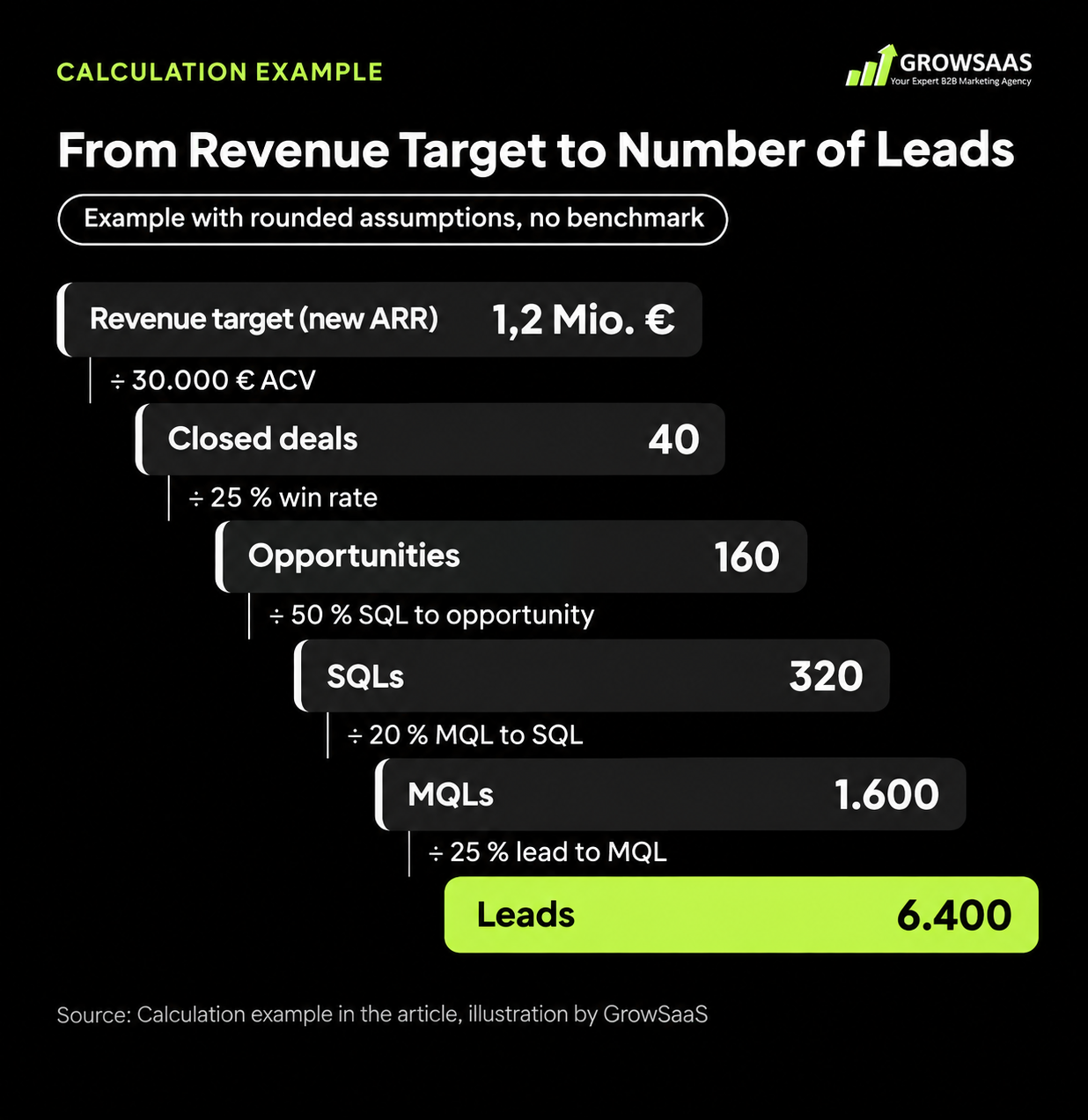
Set your time period and new ARR target. Divide the target by average annual contract value (ACV), using only recurring first-year revenue for this calculation. Exclude one-time setup fees. At €30,000 ACV, a target of €1.2 million in new ARR requires 40 closed deals.
2. Work backwards through the funnel
Divide the required number at each stage by the conversion rate from the preceding stage. Round up to a whole number where needed. The figures below are illustrative assumptions.
| Stage | Calculation | Required |
|---|---|---|
| Closed deals | €1,200,000 ÷ €30,000 ACV | 40 |
| Opportunities | 40 ÷ 25% win rate | 160 |
| SQLs | 160 ÷ 50% SQL-to-opportunity rate | 320 |
| MQLs | 320 ÷ 20% MQL-to-SQL rate | 1,600 |
| Leads | 1,600 ÷ 25% lead-to-MQL rate | 6,400 |
Agree on what qualifies an MQL, when sales accepts a lead as an SQL and when that SQL becomes an opportunity. Model channels separately if they use different definitions or skip stages.
3. Plan backwards from the close date
Allow for the time it takes leads to qualify, become opportunities and close. If it typically takes four months from opportunity to close, deals expected to close in December should already be opportunities around August. The leads for those deals need to enter the funnel earlier. Review how much of your target the existing pipeline could cover.
4. Compare scenarios and identify the bottleneck
If the MQL-to-SQL rate rises from 20% to 25%, the example needs 5,120 leads instead of 6,400, all else equal. If the win rate falls from 25% to 20%, it needs 8,000. Build a base case and a conservative case using CRM data from comparable segments where possible. Mark assumptions and update them as results become available.
Compare the lead requirement with your reachable market, budget and sales capacity. If sales accepts too few MQLs, test whether better targeting improves qualification before increasing campaign spend.
Frequently asked questions
What opportunity value do I need?
At a representative revenue-weighted win rate of 25%, a target of €1.2 million in new ARR requires €4.8 million in opportunity value measured on the same ARR basis. Account for which opportunities can close within the target period.
What if I have no conversion data?
Start with documented assumptions, test them in early campaigns and replace them with observed rates once enough deals have moved through each stage.
How often should I update the plan?
Review volumes, conversion rates and close forecasts with marketing and sales regularly, for example monthly. For long sales cycles, use cohorts that have had enough time to progress through the funnel.
Want to turn your revenue target into a marketing and sales plan? Book an introductory call with GrowSaaS.